Archery Glyph Icon: A Designer's Guide to Versatile Visuals
There's a specific kind of satisfaction in finding a design asset that just works. Not something flashy that demands attention, but a tool that integrates so seamlessly into your workflow you wonder how you managed without it. The Archery Glyph Icon is that kind of asset. It’s not merely a picture of a bow and arrow; it’s a thoughtfully crafted symbol designed for clarity, adaptability, and professional use. For anyone building a brand, designing an interface, or creating marketing materials, understanding its strengths is key to unlocking its full potential.
More Than a Symbol: The Anatomy of a Great Icon
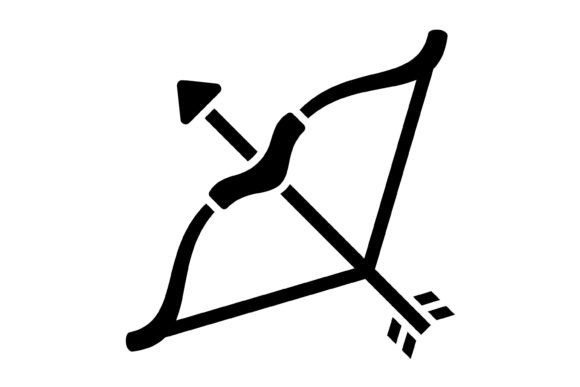
At first glance, the Archery Glyph Icon presents a clean, monolinear design. The lines are consistent, the curves are precise, and the negative space is carefully balanced. This isn’t a complex illustration; it’s a distillation of an idea into its most essential forms. Its personality is one of precision, focus, and forward momentum—qualities that can subtly influence how your project is perceived. The style leans towards a modern, minimalist aesthetic, making it incredibly versatile. It avoids trendy details that will date quickly, opting instead for a timeless quality that ensures longevity across various applications.
This icon’s true power lies in its technical foundation. As a 100% vector asset, it’s built on mathematical paths, not pixels. This means it can be scaled to the size of a billboard or a favicon without losing a single detail. The included file formats—AI and EPS for editing in professional vector software like Adobe Illustrator, SVG for flawless web integration, and high-resolution JPG and PNG with transparent backgrounds for immediate use—cover virtually every scenario a creative professional might encounter. This isn't just a single icon; it's a complete toolkit for consistent visual communication.
Where Focus Meets Function: Practical Applications
Let's talk about real-world use. The Archery Glyph Icon shines in contexts where clarity and symbolism are paramount. For mobile apps and websites, it’s perfect for representing features like "target audience," "goal setting," "precision tools," or "performance metrics." Its clean lines ensure it remains legible even at small sizes on high-density screens, which is a critical consideration for web design and user interface work. In presentation templates, it can visually reinforce points about strategy, hitting targets, or achieving objectives without cluttering the slide.
For brand identity and logo design, the icon can serve as a foundational element. Imagine a fitness brand focused on personal goals, a marketing agency promising targeted results, or a project management tool about hitting deadlines. The archery symbol provides a strong, recognizable starting point. In editorial design and packaging design, it can be used as a recurring motif, a chapter marker, or a decorative element that ties a visual theme together. Its consistency across all formats ensures that whether it's printed on a brochure or displayed in a social media graphic, it maintains the same professional standard.
Integrating with Purpose: A Strategic Approach
Simply having a great icon isn't enough; using it effectively is what separates good design from great design. The first step is evaluating project fit. Does the concept of "archery"—precision, focus, a clear trajectory—align with your message? If you're a craft blogger, it might work beautifully for a series on "honing your skills." If you're a financial advisor, it could symbolize "aiming for your financial goals." The connection should feel intuitive, not forced.
Next, consider font pairing if the icon is used alongside text. Because of its clean, geometric nature, the Archery Glyph Icon pairs exceptionally well with both sans serif fonts for a modern, tech-forward feel and classic serif fonts for a more traditional, authoritative look. Avoid pairing it with overly ornate script fonts or handwritten fonts, as the contrast in complexity can create visual tension rather than harmony. The goal is a balanced visual hierarchy where the icon and type support each other.
Finally, leverage its versatility. Use the SVG version for your website to ensure crisp rendering on all devices. The transparent PNG is ideal for layering over images or colored backgrounds in social media graphics or print materials. The editable vector files (AI, EPS) are your best friends for custom projects—perhaps you need to adjust the stroke weight to match your brand guidelines or incorporate it into a larger custom illustration. This adaptability is what makes it a truly premium font asset, offering long-term value far beyond a one-time use.
Key Considerations for Your Workflow
- Readability at Scale: Always test the icon at the smallest size you plan to use it. Its strength is maintaining clarity, but you should verify this in your specific context.
- Color Application: While it works perfectly in a single color (black on white or white on black), don't be afraid to apply your brand's color palette to make it uniquely yours.
- Commercial Use: The included licensing typically allows for broad commercial use, from client projects to merchandise. Always review the specific license terms to ensure compliance for your intended application, especially for commercial font and asset usage.
The Archery Glyph Icon is more than just a design asset; it's a strategic tool. Its thoughtful design, technical robustness, and symbolic resonance make it a valuable addition to any creative's library. By understanding its personality and applying it with intention, you can enhance your projects' professionalism, strengthen your brand identity, and communicate your message with greater precision and impact. It’s a small investment that can yield significant returns in visual coherence and audience engagement.